

In a time when compassion should be our compass, I find myself asking: Who truly cares about those who need everyday support today?
We’ve come a long way. We moved away from institutional care, recognising its limitations and the isolation it imposed. We embraced community care an approach rooted in dignity, inclusion, and the belief that everyone deserves to live among us, not apart from us.
But now, unsettling decisions from those in power suggest a reversal. Policies that seem not only uninformed but deeply uncaring are pushing us back toward a model that hides people away. Out of sight. Out of society. Out of choice.
This isn’t just about policy, it’s about people. Real lives. Real stories. Real needs. And the question remains: Who is standing up for them?
We must not allow those who need support to be reduced to statistics or sidelined by systems. They deserve more than survival; they deserve a life. One with joy, autonomy, and connection.
So I ask, with urgency, Do You Really Care?…
Well at ubu We Do..
Because we do, we must speak out. We must act and not let silence become complicity. At ubu, we don’t wait for permission to do what’s right. We lead with purpose, because the people we support deserve nothing less.
When Leadership Fails, We Step Forward
When policies are made behind closed doors…
When decisions are rushed, disconnected, and damaging…
When those in charge lack the experience to understand the lives, they’re shaping…
Who speaks up? Who leads?
We Refuse to Be Silent
We see what’s happening.
We see policies that push people back into the shadows.
We see systems that strip away choice, dignity, and independence.
We see leadership that listens to headlines, not to people.
And we say, Enough, We Stand for Something Bigger
We stand for a world where care is not a transaction, it’s a relationship.
Where people are not hidden, they are included.
Where leadership is not about power, it’s about responsibility.
We will not let short-sighted decisions undo decades of progress.
We will not let bureaucracy silence the voices that matter most.
We will not let fear or fatigue stop us from fighting for what’s right.
This Is Our Call to Action
To families: Your voice matters. Use it.
To other professionals: You are not alone. We will Stand with you.
To policymakers: We are watching. We are ready to work with you, not be ignored.
To the public: This affects all of us. Speak out. Show up. Share the truth.
To Be Heard We Must All
Speak up. loudly and often. Whether through blogs, letters, social media, or public forums, we must make our voices impossible to ignore.
Organise and mobilise. Join forces with advocacy groups, community organisations, and allies who share the vision of inclusive care.
Engage with decision-makers. Write to MPs, attend consultations, and demand transparency and accountability in policymaking and public services.
Share experiences. Personal experiences are powerful. They humanise the issue and remind others that behind every policy is a person.
Refuse to be silent. Silence is complicity. Let’s be the voice for those who are being pushed into the shadows.
Let’s Lead Forward, Together
We are not waiting for change.
We are not asking for permission.
We are building a future where every person, regardless of ability, background, or circumstance, has the right to live fully, freely, and with dignity.
And here’s why we All must act now:
These are not just numbers. They are lives. They are futures. They are the reason we must lead.
The Numbers Speak for Themselves
Policy changes in 2025 have had a profound and measurable impact on independent living, community care, and the sustainability of the social care sector. Here’s what the data reveals:
Funding and Financial Pressures
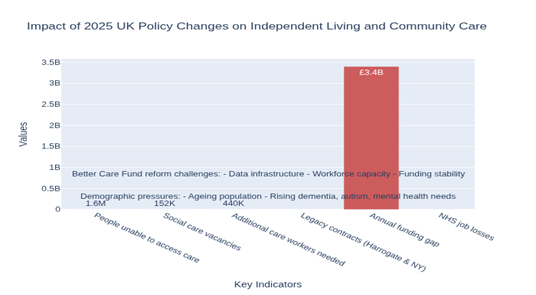
- The Health Foundation estimates that adult social care in England requires an additional £3.4 billion annually by 2028–29 just to maintain current service levels
- Local authorities are facing crushed budgets, with many unable to meet rising demand. This has left community care services entirely dependent on independent providers, whose viability is now under threat
Workforce Crisis
- The sector faces extraordinary workforce pressures, with low pay, limited career progression, and high turnover contributing to chronic shortages
- Recent changes to visa and immigration rules have further compromised international recruitment, which had been a lifeline for many providers
- The government’s own strategy acknowledges the need for a 10 year attraction plan, retention pilots, and a national programme to recruit graduates and career changers
Impact on Services and Outcomes
- 1.6 million people in the UK are unable to access the care they need
- The sector faces 152,000 vacancies, with providers leaving the market at an alarming rate
- 80% of us will need social care in our lifetime, and to meet demand, we’ll need 440,000 more care workers over the next 11 years
- The government’s own reports warn of the cost of inaction, urging urgent reform to avoid further damage to individuals, providers, and the NHS
- The Better Care Fund (BCF) reform aims to shift care from hospitals to homes, but implementation is uneven. Many regions lack the data infrastructure, workforce capacity, and funding stability to deliver on these goals
- In Harrogate and North Yorkshire, 56% of supported living contracts are legacy agreements with the lowest hourly rates in the market
- The abolition of NHS England is expected to result in over 9,000 job losses, with ministers claiming the move will save “hundreds of millions” to cut waiting times, but providers warn of disruption and fragmentation
Demographic Pressures
- The UK’s ageing population and rising prevalence of dementia, autism, trauma informed, and mental health conditions are driving unprecedented demand for personalised, community-based support
These statistics are not just numbers. They represent real people, families, carers, professionals, struggling to navigate a system in crisis. They are the reason we must all lead with urgency, clarity, and compassion